Cottage Daze

Cottage Kitchen
The Cottage Kitchen with Electricity Installed

While our children were growing up, we had the use of the my husband’s parents’ cottage in the Gatineau Hills.  Those days at the lake are my idea of heaven.  Getting there, however, was a major undertaking.  In the early days, we had a compact car into which we had to load four children, one furry dog, all our luggage, plus food and water for two weeks.  It was not the most comfortable of rides. It certainly illustrated what made a compact car compact.

After packing everyone’s swimsuits, toothbrushes, towels and shorts and baking up a storm, not to forget cleaning the household to impress the mice while we were away, I would roll into bed exhausted so I could drag myself out of bed a few hours later for the car loading.  We never got out of our laneway when planned.  Something always needed more attention or we’d get on the road and half-way down, remember that we’d forgotten to drop off the key at the neighbour’s or we’d left something vital at home.  Our neighbours must have been amused at how many times we’d return.

Inside the car, we’d have three children in the back seat, one in between my husband and I, as well as the dog at my feet.  Our trip into the hills from the country took us two hours.  That is two hours of children complaining about elbows in their ribs and feet on their side of the car.  Then, just to make things even more comfy, we’d stop half-way to buy groceries.  We squeeze back into our car, but now with the added weight of a grocery bag on each lap, because the trunk was already full.  The unfortunate person who got the milk bags had to endure freezing legs (usually in shorts) all the way up to the cottage.

The road to the cottage was accessed through a farmers yard and so the gate had to be opened before we could continue. This meant that someone had to get out of the car to do the deed and there were always lots of volunteers.  The road in was a gravel one with many twists, turns and dips with the children getting more excited at every landmark.  Once at the cottage, we didn’t so much step out of the car as launch from it.  The car doors would explode open and the children would shed their grocery burdens to rush down to the dock.  At this point, their father would issue a sharp,”Hold it!  No one goes anywhere until we carry in our bags.”   Reluctantly, our troops would return to the car so they could hustle the groceries and luggage inside.  The dog, oblivious to all the ado, would trot down to the lake to check out the frogs and fish.  He never caught any, but he spent days staring into the water, fascinated by their movements.

Now, this cottage was functional, not palatial.  The cottages on either side boasted running water and electric lights.  Not so ours.  Well, electricity did come later, but for awhile it was strictly gas lamps or kerosene.  The only water we got for washing hands and dishes, came up from the lake carried by child labour (when they were old enough to carry the buckets).  We had no television there, no radio and all our entertainment was found in the book case where there were stacks of board games for rainy days or books to be read aloud.  Otherwise, we were in the lake, on the lake, by the lake or in the deep piney woods.  Oh, yes, there was also a huge sand pile behind the cottage where to this day a number of rusted Hot Wheels may still be buried.

The heat for the cottage was supplied by a pot bellied Quebec heater stove into which we shoved logs from the woodpile beside the cottage.  There were three bedrooms off the main kitchen/living room.  The walls of these rooms did not go to the ceiling, so when the heater was stoked the warmth spread throughout the cottage.  At night we snuggled down into our sheets under a couple of blankets and some quilts.  In the morning, my husband got up and started the fire, while we all stayed under the covers, waiting until the air warmed up enough to brave the cold linoleum floor.  Most mornings, father and kids got into their swimsuits and went dashing off the end of the dock, headfirst into the cool water.

After breakfast, the children would disappear out the door to explore the wilds of Quebec within a whistle’s distance from the cottage.  When we eventually got a truck that could hold bicycles, the distance of their travels increased, and occasionally included a steep hill they nicknamed “Suicide hill”.    A ride down this hill sometimes resulted in a few bruises sustained in a crash landing.  The children also had a favourite rock they named “The Rock of Giboulder” where they would play knights or outer space.  It was a wonderful playground for children.

Fishing was a great activity.  The children took turns going fishing with their father, while I curled up in one of the adirondack chairs to read.  My summer reading never got very ambitious beyond romance novels, of which there was an abundance.   Otherwise, I would wander down to the dock and dangle my feet in the water or go in swimming with whatever children hadn’t made the rowboat.  When the rowboat returned, we were all very excited to see the catch which was afloat in a bucket of water.  The anglers were anxious for applause, but leery of my motives, as I am a lover of fish as a food.  Unfortunately, my children did not share my epicurean enthusiasm, and most of the fish would be named and duly returned to the deeps of the lake with a sore mouth.

Rainy days at the cottage were spent with cards in our hands or around the Monopoly board.  Our games tended to be loudly hilarious with the dog curled up under the table on the screened-in porch while the rain made polka dot splashes on the lake and drummed on the cottage roof.  Our meals were whenever we got hungry.  We had stopped looking at our watches two days into our holiday.  I made simple meals; I knew a hundred different ways to cook ground beef.  Clean-up meant boiling the lake water on the stove, so it was best to keep the dishes to a minimum.  When we finished eating, we all returned to whatever activity we’d been doing before.

As the sun went down, my husband would light the gaslights and get out the latest book he was reading aloud to the children.  He read fantasy books by Terry Brooks or by Robert Asprin , giving all the characters a voice or accent of their own.  We all enjoyed those times and went off to bed happily tired from laughing.

Then again, getting ready for bed, required a trip to the outhouse with a flashlight.  Not everyone’s best moment.  An outhouse during the day was scary enough, as there were huge spiders lurking or  maybe a wasp.  At night the trip to the outhouse was just plain unnerving.  It’s one thing to see and know what might lay in wait, it is quite another to imagine it.  Most of us would drag our feet out there as if going to the gallows, and return at a gallop.  No one ever lingered.

Oh yes, I love those memories: the cook outs, the marshmallow roasts, the long walks down shaded lanes, the serene swim at dawn on the silky smooth lake, the happy shouts of children as they splashed off the dock, paddling the canoe up behind a turtle or a loon,  the mist coming off the lake,  the crackling of the logs in the stove, and even the clean-up before heading home.  Yes, definitely heaven.  I don’t know why I’m thinking of this tonight, but I suppose the smell of spring in the air and the return of all the songbirds, makes me nostalgic for the coming of summer and summer used to mean a trip or two to the cottage.  Happy days indeed.

The Hymn I Wrote for Communion

05-holy-communionWriting hymns has become a great joy to me.  Music can convey so much.  I strive to write simple lyrics that anyone can understand and hopefully they will linger in the mind long after the music has ended.  Last Sunday when we had communion we sang this hymn that I wrote in 2008.  If you wish to use it, please contact me through this blog.


The Table of the Lord

© 2008  Mollie McKibbon

8  8  8  8

Our food is here; the table spread,

We poured the wine and broke the bread.

This costly meal none can afford,

Provided freely by our Lord.


Come drink the wine and eat the bread.

Come hear the words our Master said.

“This is my body and my blood,

Now love each other as you should.”


“I spend my life-blood for your sake,

And though my body they will break,

My friends, I promise you will be

One day in paradise with me.”


Our food is here; the table spread.

We poured the wine and broke the bread,

This costly meal none can afford,

Provided freely by our Lord.

Crown of Glory:Crown of Thorns (Christian dialogue for Palm Sunday)

one palm

Crown of Glory; Crown of Thorns
Dialogue for Palm Sunday
© 2013 Mollie Pearce McKibbon

crown

Dialogue One: Crown of Glory

Dinah and Shem are a brother and sister in the crowd when Jesus
rode into Jerusalem on a donkey in the beginning of Passover week. Dinah is peering around Shem trying to see Jesus.

Dinah: Shem, do you see him? Has he come through the gate?

Shem: Not yet,Dinah. I can see palms waving though.

Dinah: I wish I were as tall as you are Shem, then I could see over the shoulders. Did you ever see such a crowd?

Shem: Excuse me, excuse me. Come on, Dinah. You stand right here in front. Now you will see too. I’m right here behind you.

Dinah: Thank you, Shem. You are a good brother. Oh Shem, I think I see Simon Peter. And isn’t that Judas and there’s Thomas laying his coat down on the road.

Shem: Yes, and look, behind them is the Master. He’s riding on a donkey! I wonder why he isn’t on a horse. A donkey isn’t a proper mount for a leader.

Dinah: Wasn’t there something in the scriptures about a king coming on a donkey? Oh, look at the crowd of followers. They are singing and shouting, Shem.

Shem: They are shouting “Hosanna in the highest”. Hosanna! Hosanna!

Dinah: Hosanna! Hosanna! Hosanna in the highest!

Shem: Hey, don’t shove. My sister is here. What happened to manners?

Dinah: Shem, it’s all right. It’s the temple leaders. Look, they’ve stopped the procession.

Shem: Now what? More trouble? Why do they always have to horn in?

Dinah: Shh! Shem, be careful what you say.

Shem: Well, it’s true, Dinah. Every time the Master tries to teach, those characters are always hanging around, always trying to cause some kind of trouble for Jesus. Can you hear what they are saying?

Dinah: I think they want the Master to quiet the crowd. It’s hard to tell for all the noise, but they keep gesturing at the palms and people. One of the Scribes is telling those people to go home, I think.

Shem: I don’t think he will be successful. We have been waiting for this day a long time. Now the Romans will sit up and take notice. They can’t push us around any more.

Dinah: Shem, you’ve got to be careful. I don’t think the Master wants to start a rebellion. He’s a healer.

Shem:Dinah, he is much more than that. He can raise people from the dead! Remember what I told you about what Saul said happened at Bethany? Don’t you think that the temple leaders will want that hushed up? Look, the Pharisees are backing off. The crowd is getting even larger.

Dinah: Oh, Shem, do you think the centurions will come? Will they try to arrest Jesus?

Shem: Just let them try! Just let them try and they will have to face the whole of Jerusalem! We’ve just been waiting for an excuse and a true Messiah to lead the way.

Dinah: Shem, you frighten me when you talk like that. The Master has never spoken about rebellion. Never have I heard anything but kindness from his mouth.

Shem: He can hold his own against the temple crowd,Dinah. He sees through their tactics, always so cooperative with the Prefects that come from Rome.

Dinah: It’s over now, Shem. We’d better go home.

Shem: This is only the beginning,Dinah. Mark my words.  Things will be different from now on.

crown of thorns #2

Dialogue Two: Crown of Thorns

Shem and Dinah have been caught up and separated in the crowd watching Jesus make his torturous way to the hill of Golgotha.

Dinah: Shem! Shem! Oh Shem, I thought I would never find you!

Shem: I thought you were going to go home,Dinah. I was hoping that you hadn’t seen what happened.

Dinah: I couldn’t go home. I just had to know what was going to happen to the Master.

Shem: Did you see it all,Dinah? It was awful.

Dinah: When Saul told us he’d been betrayed and arrested, I couldn’t believe it. Not after what happened when he entered Jerusalem. How could his friend, his disciple turn on him, Shem?

Shem: Why did the Master let it happen? That’s what I can’t understand. A man of so many miracles and yet he stood there meekly, letting the Roman guard push him around, spit on him, call him names and not a word, Dinah, not a word.

Dinah: But what has happened to his followers? Where did they go? Why didn’t they protect Jesus?

Shem: I don’t know. I don’t understand any of this. We had such hopes, such dreams to be free of this domination.

Dinah: But Brother, the Romans rule the whole world. How can we change that?

Shem: We couldn’t , not by ourselves, but with Jesus leading us, so much would have been possible. And now, it seems, he is just like all the other “messiahs”, a big disappointment.
Dinah: Shem, you can’t mean that. The Master has done so much, taught us so much. He never spoke of revolution… he never talked about changing governments…he talked about us changing, about heaven and God.

Shem: Well, the Sanhedrin certainly made short work of his trial…what a sham that was. Saul was there and he saw the Master’s disciple John there and he thought he saw Simon Peter, but no one spoke up for Jesus, except for the priest, Nicodemus.

Dinah: Did he? He was very brave to do that, Shem.

Shem: Well, too little too late, I’d say. Saul said they soon shut Nicodemus up.

Dinah: Was that when they took Jesus to Pilate? The first time, I mean.
Were you there then?

Shem: Yes, I was. I’m glad you weren’t.

Dinah: Oh, I was there, just not close enough to see anything. I couldn’t hear anything either…too much shouting.

Shem: The soldiers had dressed him in a cloak and put a crown of thorns on his head, I could see the blood trickling down his face. They sent him over to that snake, Herod.

Dinah: Oh brother, you must tether your tongue. It worries me about how outspoken you are. Herod has as many spies as Pilate.

Shem: Yes, my tongue causes trouble all right. I could rip it out right now. I am so ashamed, Dinah.

Dinah: Why, whatever have you said? Are you in trouble?

Shem: No, I’m not in trouble. I am a coward though, after all my brave talk.

Dinah: I’m not very brave, either, Shem. I have discovered this day how very feeble my spine is. All it took was some big centurion near me and when Jesus was brought back in front of Pilate and he offered the crowd the chance to have that horrible murderer freed or Jesus freed, I started to yell for Jesus but, then when everyone glared at me, I yelled for Barabas. I still can’t understand why.

Shem: And when Pilate said he could find no reason to punish Jesus, and the crowd yelled “crucify him” so did I. There was no centurion near me, Dinah. I was just afraid the rabble would turn on me. Why did I do it? Jesus has never done anything to me, except kindness.

Dinah: Oh Shem, we have much to be forgiven. Did you see how he stumbled under the weight of the cross? I shall never forget this day. I feel so awful, so awful. Let’s go home. I want to pray.

Shem: Yes, we’ll go home. I won’t sleep tonight for nightmares. What a terrible, terrible day!

The Beginning, Not the End.

We presented this dialogue instead of a sermon on Palm Sunday. We followed this presentation with a prayer of confession and the assurance of pardon. Then we sang a final hymn.

(Please contact me through this blog for permission to use this dialogue.)

The Sandals

6907easter_lily_crossI wrote this poem 13 years ago (how time does fly) and now I see so many things wrong with it, but I still like the story, so here it is.

The Sandals 

©2000 Mollie Pearce McKibbon


I was busy at work on my bench one day,

My leather and tools all around me lay,

When a weathered centurion ventured in

With a pair of sandals, shabby and thin.


“Repair these, cobbler, you have one day”

When I disagreed, he said he would pay

A week’s soldier’s wages if he could be sure

That they would be ready in one day, not more.

I nodded my head; it was too much to pass,

Everything else I would take off my last.

He sighed in relief and left in a hurry.

I shrugged as I pondered his manner so surly.


What possible use would he have for such shoes,

Ragged and scuffed from miles of abuse?

I considered their obvious poverty state-

Nothing a Roman would value; third rate.

A week’s soldier’s wages was a very high cost

For something most likely a servant had lost.


It was late and the shadows were filling my shop.

I had promised my wife, before dinner I’d stop.

As I placed the sandals above on a shelf,

Something inside me prevented myself.

I wrapped up the sandals, unmended and worn,

And carried them home with me until morn.

I laid them carefully by my bed for the night

And slept without stirring, no dreams of great fright.


When I woke, my wife asked me why I was giving such care,

To something only a beggar would wear.

I couldn’t explain it and she shook her head,

“They’re not made of gold or silver,” she said.

“They’re worth a soldier’s salary here in my hand”.

Money was something that she’d understand.

But her face turned pale and she recited a verse

From the Torah, and shivered,”Perhaps they are cursed.”


“Such shouting we heard in the street yesterday,”

Remember how Romans make everyone pay.

Oh Husband, dear Husband, take care what you do.

Your good reputation may depend on those shoes.”

In spite of her fears, I wrapped them up tight,

And carried them back to my shop at first light.


I recovered the soles and strengthened each thong.

As I worked on the leather, my heart filled with song.

If a week’s wages purchased my cobbler’s good name,

What more could I garner, what more could I gain?

When the centurion returned, his wages in hand,

I wouldn’t accept the price that he planned.

He paused and considered, a moment not more,

Then turned on his heels and went out the door.

All day I was angry at my foolish thought;

The sandals were mended, but what had I got?


That evening the soldier returned once again,

His gaze it appraised me and he grasped my hand.

He said in a whisper, with tears on his face,

“I have no more money, no way to erase

The pain that I caused an innocent man,

On Friday I hammered the spikes in his hand,

And as He hung there, high on the cross,

I won these sandals with dice that we tossed.

I haven’t slept since that horrible day,

Yet, somehow, I just couldn’t throw them away.


As he urgently spoke of his horror and grief,

I remembered the look on the face of a thief

Who passed by my open shop door on the way

To his execution, to die that same day.

I recalled this same soldier was part  of the mob

That marched in the legion in charge of the job.

He paused and I muttered, “No blood money, please,

I saw what you did when He fell to his knees.

I saw His raw back and the blood running down

From the thorns on His head they’d made into a crown.

No money you’d pay me would ever reverse,

My greed and your torture; we both will be cursed.”


The soldier, a veteran, as his grave scars attested,

With a sob in his voice, earnestly protested.

“Yes, we’re both sinners, that can’t be denied.

I witnessed his agony and watched while He died.

No amount you demand, nor could I afford,

Would pay for the sandals worn by my Lord,

But Cobbler, I tell you, we both are forgiven,

These sandals are needed because He has risen!”

My Very First Hymn


In 2001 I wrote my first hymn.  I have always written, but never did I imagine writing a hymn.  There was a hymn that I wanted to use in our service, but our organist disliked the words.  I said (, thinking “how hard could it be!” ) “Will you play it, Doris, if I write new words for it?”  Doris said she would and so I embarked on a journey that has proved both very exciting and very difficult.  You see, I don’t read music.  I’ve never played an instrument.  But, ignorance is bliss, so I started.  Oh my, the crumpled paper!  The erasures!  The scribbled lines that didn’t make the final draft.  Anyhow, here it is and I am still writing.

In the Beginning

©2001 Mollie Pearce McKibbon


In the beginning, all was in silence;

Darkness and water covered the earth.

God’s Word made sunlight, moon-glow and star-shine,

Green grass and flowers, birdsong and mirth.


God’s Word is blessed, God’s Word is sacred,

Brought forth as human, caring and kind;

Healer and teacher, prophet and Saviour;

Love resurrected, King beyond time.


Word of elation, Word of salvation;

Jesus, beloved, full of God’s grace.

Wonderful counsellor, Manna from heaven;

All that You are God, shines from your face.


May the world praise You, O God Almighty,

May we all sing praise, ever to You.

Open our hearts God, to your Word spoken,

Make your Word known, God, all the world through.


I was really thrilled when the Southern Ontario Chapter of the Hymn Society  chose this hymn, along with hymns from three other writers, to be sung at a Hymn festival in Toronto.  It was thrilling to hear it sung by a wonderful soprano and then by a full choir.  If anyone would like to use this hymn please contact me through this blog as I do own the copyright.bible in hand

Adeline’s Journal (January – March 1813)

silohuette of Ada Mae

Adeline’s Journal – a fictional account of a Young Woman’s Life During the War of 1812
© 2012Mollie Pearce McKibbon

January 23, 1813

Thistledown Farm, Edwardsburgh Township

Dear Janetta,

It has been extremely cold, but our little house is cosy.  My brother, William, made a brief visit home two days ago and brought us the mail, a package and news from Fort Wellington.  William said that the mail was a few months old because it had been taken from an English ship by the Americans who had hoped to intercept military information.  It was then discarded by them as it was only family mail for the soldiers and settlers.  That explained why all of the letters had been opened.  

Mother was overjoyed to have a letter from her sister, my Aunt Sadie, from Bath and I received a most happy surprise – a letter from you, Janetta, after all these years.  You apologized for being so negligent in corresponding, but you also told me that a great many things had occurred – both good and bad, since we had left England.  You lost your dear mama to pneumonia and your father had remarried soon afterwards, much to your chagrin.  Your brother was wounded fighting Napoleon and had lost an arm.  However, the good news was that you had your first season in London while visiting your aunt and uncle.  It all sounds so wonderful – all the parties and dances.  Now you are being courted by not just one young man, but three.  That did make me smile.  However will you decide between them?

What shall I write back?  There are so many years to fill in for you.  Will I tell you about Charles?  Evvy says that you have nothing to boast over me because I have three suitors also, but it is hardly the same.  Robert and Arthur Randall are only interested in me because I am the only eligible girl in the vicinity.  There is Kathleen O’Meara, but  she is two years my senior and has shown little interest in any one,  Evvy thinks she is sweet on Arthur, because he spends so much time with her brothers.  There are three O’Meara brothers, Liam, Darnell and Seamus.  I don’t think that Robert or Mr. Randall approve of the O’Mearas.  There have been rumours going around about them and the time they spend on the American side of the river.  Of course, rumours are always circulating about the O’Meara family.  They haven’t lived here in Upper Canada very long and they haven’t been shy about voicing their dislike of the English.  Father says that Mr. O’Meara left Ireland under a cloud (whatever he meant by that) and that he thinks the O’Meara’s aren’t entirely unsympathetic to the Americans.  However, no more gossip.

I also received two letters from Charles.  He asked William to bring them to me and William saw no harm in it.  I think William likes Charles and why ever not!  He is a very fine gentleman , respected by all the other soldiers and militiamen (excepting Arthur of course).  Both Charles’ letters were very kind and amusing.  In the first one, written after our embarrassing scene at the New Year’s Eve party, he begged my forgiveness for causing me to be the topic of gossip.  He also reassured me that he was not involved with any other woman.  He speculated that the picture Robert Randall had seen was of his sister, Persephone, who was also my age when it was painted.  He wrote that his sister was married and had two little girls now and he hoped that one day I would make her acquaintance.  

Charles’ second letter was filled with descriptions of his home in England and his two older brothers, Everett and Bartholemew who are both serving in the army under General Wellington.  They both have commissions of course, but then they are his older brothers.  Evidently Charles’ father and grandfather were both army officers, so military life has been their family tradition going back even to the time of the War of the Roses.  

Our family, the Prices of Yorkshire and Buckinghamshire have always farmed.  There is quite a lot of land in our family as Great Grandfather Price was a squire, but  he had five sons, and my grandfather was the youngest, as is my father the youngest of seven.  Father was managing Grandfather’s land for his eldest brother, but they fell out and now here we are in North America.  I suppose General Houghton would not consider us in his class at all.

Mother’s package hadn’t been opened at all.  Perhaps the Americans were in too much haste to bother.        It turned out to have been sent by Grandmother Benton, mother’s mama.  She sent us some delicate lace capes to wear over our summer dresses on Sundays.  They really aren’t suitable for our summers that tend to be very humid and full of biting insects.  Mother says that perhaps she could apply the lace to a wedding gown for each of us one day or (and she said it quietly so that Elizabeth wouldn’t overhear) to make a christening gown for the family grandchildren.  Elizabeth is still very sensitive about losing her baby.  I think mother had been hoping for something more practical from Grandmother Benson, such as real tea or some spices.  We lack so much now in the way of supplies.  The Americans are constantly harassing our shipping and any boat the comes up the St. Lawrence from Montreal or down the river from York is liable to be threatened.  Mother has to be very careful with the supplies we have and most of our meals rely upon the contents of the root cellar.  Henry rabbit snares and turkey shooting supplies us with meat.  Of course, things haven’t been so good in England either, now that they are at war again.

Lovingly, Adeline 

February 13, 1813

Dear Janetta,

We just seem to dig ourselves out of one snowstorm into another.  The wind has been howling around our little home and piling snow up against the door, so that each morning we have to dig our way out of the house to get to the barn.  There was a bit of a thaw last week and now there are icicles hanging off the roof that almost touch the ground.  We need to melt the snow for water for the animals and believe me, it cools off before we get it to the barn.  

The Americans made another raid, this time against Elizabethtown ( I just can’t get used to calling it Brockville) and they released fifty prisoners, and took several prominent citizens to Ogdensburg as their prisoners.  They are becoming bolder and bolder and we are all worried that Prescott will be next.  Heaven forbid they should capture Fort Wellington!  We are very worried about Father and William.

My sister-in-law, Elizabeth, is staying with us for now.  It is hard enough to keep one home going without having to travel back and forth between two.  William went up to their farm, secured it and brought their cow and horse back with him so our barn is quite full now.  Elizabeth is quite recovered now and so she, Mother, and Evvy look after the house, the meals and the mending.  Henry goes hunting and I care for the animals.  

Father and William spend most of their time at the fort now, going out on patrol.  There is quite a bit of smuggling going on and a few folk have been caught and had their ill-gotten goods confiscated.  I can’t say that I don’t feel any empathy for the people who have relatives on the American side, but I don’t believe that trading with the enemy is anything but treasonous.

Faithfully, Adeline

February 15, 1813

Dear Janetta,

If much more snow falls, I doubt we will have arms long enough to pile it up.  When I go out now, I bundle up like Father.  Mother insists I put on Father’s heavy wool leggings on over my woolen stockings under my woolen skirt.  I do look a fright when I go to the barn, I suppose the cows mind it little.  I only wish there was some way to make my leather boots resistant to the wet snow.  After the chores, my feet are cakes of ice.

I think that I shall have to purchase some winter moccasins from Grandma MacTavish.  We all call the elder Mrs. MacTavish, Grandma because she is a dear old lady who lives with her son and his family in Johnstown.  She lived with the Algonquins when she was just as small girl about six years old until she was 14.  She learned how to sew moccasins which she sells to the settlers now.  She says they are much warmer than our leather boots.  I believe we settlers could learn a great deal from the native tribes about survival in the harsh winter.  

I have become better acquainted with Charles over the past weeks through our correspondence.    Mr. Randall , who is too old to be in the militia, goes back and forth to the fort each week to take their meat supplies from the farmers in the area and he fetches the mail and he has been very obliging to deliver our letters to our men at the fort.  

Charles has been circumspect in all his letters, telling me about his home in England and regaling me with amusing stories his dog, Plato and his horses.  I have told him all about where we farmed in Buckinghamshire and how we came to live here.  He mentioned in his last letter that the whole fort was being kept to a very high standard of readiness in anticipation of another attack by the Americans.  

Mr. Randall says that the Governor-in-chief is expected soon for inspection and “Red George” MacDonell is fighting mad because the American commander, Forsyth, has insulted the capabilities of our troops.  Sometimes, I wish I was a man I feel so angry, but then I am glad I don’t actually have to shoot at anyone.   

Your friend, Adeline

February 16, 1813

Dear Janetta,

Henry came back from hunting today with some disturbing news.  He was following a white tail deer just south of William’s property when he noticed smoke.  He wanted to go and investigate , but he knew that he needed to return home with some meat.  He didn’t manage to get the deer but his snares caught two fat rabbits.  He and I will go and investigate the source of the smoke on William’s property tomorrow.  Elizabeth is concerned that we might be putting ourselves in harm’s way, but she is naturally perturbed about anything or anyone putting their home in jeopardy.  I speculated that perhaps some Iroquoin hunting party had simply camped overnight and that seemed to mollify her, but Henry and I will take the utmost caution as I have assured Mother.  She is not in favour of our expedition at all, but she understands our concern for the security of William’s and Elizabeth’s home.

Adeline

The following excerpts are from Evaline Price’s Journal:

February 20, 1813

It has been three days since Henry came rushing in the door in great anguish calling ” Addie’s been taken…Addie’s been taken!”  

Still we have no word of what has happened to my dear sister excepting what Henry was able to tell us which wasn’t very much.  He and Adeline went out to William’s property to be certain that all was well because Henry had observed some smoke coming from that direction while out hunting the day before.  Adeline suggested that Henry circle the perimeter of the property while out hunting the day before.  When Henry finally came back to where they had parted, there was no sign of Adeline where they had planned to meet.  Henry approached the cabin, observed that the door was partly opened and there were signs of a struggle inside with the table and chairs pushed over and a broken jug against the wall.  Someone had used the hearth recently and there were some soiled bandages in the ashes.  

When Henry looked in the barn he said that there had been at least three, maybe four horses in there, judging by the all the disarray and horse dung left behind.  Henry rushed to the road to see if he could find any sign of a party on horseback and though he called out Adeline’s names there was no answer.  He did find one of Adeline’s hair ribbons in the snow near the cabin, so he knew that she had been there.  

Mother is terribly distraught and Elizabeth is blaming herself for allowing Adeline and Henry to go up to the property, which is silly.  Once Adeline decides on a course of action, none can deter her from it, except Father.  Mr. Randall and Henry went back to the cabin on the following day and found nothing more.  Mr. Randall called on our nearest neighbours, the O’Meara’s and the Willins, to no avail.  No one had seen Adeline.  

Father and William have been told, but are unable to leave the fort as “Red George” has them on alert, but the whole contingent is aware of Adeline’s disappearance and will be looking for any sign of her.  I have bitten my nails down to the quick with worry.  The best thing to do, Mother says, is to keep busy, however I have seen her going to the orchard where you can just see Virginia’s grave stone above the snow and Uncle Andrew’s not far from it.  I know she is grieving and there is naught that I can do to help.

Sadly, Evvy

March 3, 1813

Praise the Lord, our sister has returned!  She is pale and thin, wounded slightly and exhausted.  All we know of her ordeal is that she was rescued from imprisonment in Ogdensburg by our gallant militia men and the soldiers who carried out a surprise attack on that town and its armories on February 22.  Our brave commander, “Red George” MacDonnell, defied the orders of Sir Prevost, and led our men across the frozen St. Lawrence under the cover of darkness.  How Adeline got to Ogdensburg and what happened there will have to wait until she tells us.  At the moment, all she can do is sleep and recover, with us tenderly watching over her. 

Cpl.  Houghton has been most anxiously waiting an opportunity to speak to her and, as he was greatly involved in her rescue, Father and Mother can hardly refuse him.  Father also is recovering from a head wound he received when an American soldier hit him with his rifle butt.  William, thank the Lord, has suffered no more than frostbite to one of his toes and has returned to duty at the fort.  

Sir Prevost is, of course, taking full credit for the raid on Ogdensburg, even though Red George went totally against orders to carry it out.  More about that much later.  I must hurry now and see to Adeline’s comfort before bedtime.  Thank God, all are well.

Evvy.

Adeline’s Journal Part 7 ( January 1813)

A fictional account of a young woman’s life during the war of 1812

© Mollie Pearce McKibbon 2012regency lady

Sunday, January 3, 1813

Dearest Janetta,

It is difficult to believe that we are now in a fresh new year and that Christmas time is past.  I have so much to tell you.

Father and William were able to spend Christmas day at home with us.  Elizabeth and I have been staying here since Elizabeth had her unfortunate miscarriage.  I am happy to say that Elizabeth has recovered as swiftly as Mrs. Randall had predicted and only Mother and I know what was the cause of her brief illness.  

We decided to enjoy the holy season just as much as we could, considering the privations upon us now that we are unable to trade with our enemy across the river.  Of course it is difficult to think of dear Mrs. Trott, the dressmaker and Mr. Addler, the shoemaker as enemies, but that is what war does to friends.  We haven’t had cane sugar for some time, or any of the spices, but even so, Mother has always been frugal and she managed to mix together a lovely Christmas pudding using maple syrup and honey as well as the fruits we dried out this summer.  The pudding had scant raisins, but Mother used currants, cranberries and black berries.  Few could boast of such a delicious meal.  We ate wild turkey that Henry had managed to bag, some rabbit and some partridge.  Believe me when I say that our board was groaning under the weight of many different dishes.

Christmas Day we gathered around the hearth with our neighbours and sang songs till our voices were hoarse.  Robert Randall has a good tenor voice and he sang “I Was Born in a Stall”, and ” I Saw Three Ships” remarkably well.   Elizabeth and Evvy sang my favourite, “The Cherry Tree Carol” and Mother sang the “Coventry Carol” in her dear contralto.  I’m not much of a singer, but I tried “In the Bleak Winter” and Robert said I did it justice.  He is always kind.  Mother had gathered chestnuts which we roasted over the fire and we heated the cider for our guests.  After the Randalls departed in their sledge, we could hear the horse bells until they reached the road.  Father read the Christmas story from the Bible, we had a prayer and then we all went to bed.  

The following morning we exhanged a few gifts.  Mother had knitted us all warm mittens; mine are a soft grey.  Henry had supplied Evvy with enough rabbit skins to make Mother a new muff to keep her hands warm.  Father presented William and Elizabeth with a new chair for their cabin.  Mother made them a lovely warm quilt from two old blankets we had. I finally finished the scarf I have been  knitting  for the last two years and presented it to Father.   I gave Henry a book that my Grandfather Price had given me when I was his age.  It is stories of the Knights of the Round Table.  Father  made him a wooden shield and sword.  Evvy liked the embroidery silk Mother had been saving for her and is already planning what to make with it.  William and Elizabeth gave Mother and Father a new china jug and bowl for their wash stand which means that we can finally replace the old chipped bowl they have now.  Evvy and I gave them the embroidered samplers we’ve been working on for the past two years.  Evvy’s is perfect – two lovely blue birds sitting on a branch.  Mine is an alphabet with flowers for each letter and sadly, a mess on the back side which I covered with a lining.   Evvy has promised to help me with my sewing and I will be showing her how to do long division.  All in all, we passed a very pleasant day.

The week following Christmas was uneventful on the farm, although a fox got into mother’s geese again and we lost another.  Perhaps there will be some small ones in the spring.  Henry and I reinforced the barn door and piled stones and logs against the sides of the barn.  Now that the ground is frozen the foxes won’t be so keen to venture out of their dens.

New Year’s Eve was what we all looked forward to, as we were invited to share a Scottish New Years with the Randall family.  Father and William were once again able to come home.  We left our house  in swaddled in warm woolens and furs, with hot bricks at our feet, in the middle of the afternoon.  Of course, we carried lanterns for our return trip in the dark.  Mother had made six loaves of bread, a venison pie and a delicious rabbit stew.  We arrived at the Randall’s rambling log home at dusk and were ushered in to warm ourselves at their huge hearth.  Mrs. Randall and her sister, had prepared a wonderful meal and we were completely sated by the time they announced the arrival of their other guests, the Spencers who are planning to build a mill on the south side of the Nation River.   William arrived with Corporal Houghton and his friend, Jon Thompson, who brought his fiddle.  Soon the woods were ringing with laughter, music and the sound of dancing feet.  

I got flustered meeting Corporal Houghton again.  We hadn’t seen each other for a few weeks and Arthur’s gossip had had an effect on my attitude towards Charles.   I was polite but distant.  Charles seemed nervous and pre-occupied.  When we finally stood across from one another in the last dance before supper, he whispered, “Please come with me, Miss Adeline.”

Charles clasped my hand in his and led me over to a wooden settee along one wall.  Arthur was glaring at us from the other side of the room and I felt the heat rising up my throat to my cheeks. Charles sat down beside me as I fanned my face, but he made no move to take my other hand.  Slowly he turned to  face me and asked,” Miss Adeline, have I done anything to offend you?” 

My heart sank.  How could I explain?  Charles had ever only been complimentary and a gentleman towards me.  Perhaps I had mistaken his intent.  Had I presumed too much?  Should I tell him that I had listened to Arthur’s gossip?  And yet, shouldn’t I give him a chance to explain?

“No, of course not.  You have only ever been kind,” I said choking back tears, “but I have been informed that you may not be free to court me, if that is your intention.  Do you truly have an attachment to a young woman back home in England.”

Now it was Charles who flushed.  His eyes seemed to blaze right through me and suddenly, I was a bit afraid.  

“Who was it that told you this lie?” he growled.  “I will require satisfaction immediately!’ Charles leapt up.  All I could think, was thank goodness our host had relieved all the men of their weapons at the door.  Weapons and whiskey do not mix.

“No, please.  I should know better than to listen to idle talk. ” I dropped my fan into my lap and took both of his hands in mine.

“You shall not take the blame upon yourself.  I have been insulted and you have been misled.  The culprit will answer for it!”

“Oh, please, Charles, it must have been a misunderstanding.  People are staring. ”

The dancing had stopped and there was absolute quiet in the room.

Charles dropped my hands and straightened up.  He looked full into my burning face and said,” Miss Adeline, I am not now, nor have I ever been, involved with any other woman.  I am not affianced to anyone.  I am completely free to court you if you agree.”

I heard a gasp, and knew without looking that it had come from my mother.  William was on the point of crossing the room, when my father, stopped him with a hand and strode across the floor towards us himself.  He was clearly shocked by Charles’ declaration.

“Corporal Houghton,” he said, ” I will speak to you outside.”

“Yes, Lieutenant.  At once.”

“And you, daughter, will go and help our hostess with the supper.”

Oh, Janetta, you can believe that I hurried to obey.  I was aswirl with emotions.  Happiness and embarrassment for certain.  Mrs. Randall handed me some plates and Evvy winked at me as we set out the midnight meal.  Mother was tight-lipped, so I didn’t dare look at her.  Thankfully the flute and fiddle music resumed in a lively tune and so did the dancing.

My heart was pounding in my chest and I kept glancing toward the door.  Eventually, my father and Charles re-entered stomping the snow off their boots.  Arthur was pacing and I didn’t like the way he kept staring at Charles.  Robert took his arm and led him away, saying something about checking on the horses.  

Charles approached me at the table.  He cleared his throat and said,” Miss Adeline, I must apologize to you.  I ought to have spoken to your father first.  He has informed me that you will not be of age to court until you turn seventeen.  I am very sorry to have been so impertinent. I am not to speak to you again about this matter until I have his permission.”

I took Charles’ hand and said quietly that my birthday was in April.  “I hope you will come and wish me happy birthday then.”

Charles smiled, squeezed my hand and said,” Indeed I will, Miss Adeline.  Then Charles turned to our host and hostess and apologized for creating a scene.  They accepted his apology and then he collected his cloak and armaments and left.

And that, Janetta ,was that.   Father said no more to me about it and mother seemed relieved. We all ate supper,  William was the “first-footer” at midnight as he had gone out with Arthur and Robert to check on the horses.  So, according Scottish custom, the Randalls would have good luck in the coming year, as William is both tall and dark-haired.  We drank a toast to everyone’s health and also one to brave Sir Isaac Brock.  Then we left for home in our sledge with many warm wishes following us.  The dancing was still continuing as a few more neighbours had arrived as we left.  The woods were silent and cold as we drove home over the rough snow, but the sky was full of stars.  It seems to me that 1813 is full of promise.

Hopefully, Adeline.                                                                                                     


Adeline’s Journal Part 6 (December 1812)


Adeline’s Journal Part 6       – a fictional account of a young woman during the War of 1812

regency-belle

Saturday, December 5, 1812

Winter has made its appearance.  Yesterday we awoke to a rime of frost on the inside wall of our bedroom and a fine dusting of white on the ground outside.  Although everything looked like an enchanted land, you can be certain that Evvy and I did not spend long admiring it.  We dressed quickly to do our chores.  We have heavy woolen stockings and warm woolen cloaks to put on over our day dresses and pinafores.  Mother also knitted us some cosy woolen mitts and hats, God bless her.  I knit too, of course, but I must admit, I’m not as adept at the skill as is Evvy.  She seems to have inherited all of Mother’s homemaking ways.  I’m more bookish, Father says, but I am starved for the books to show it.  I am good at figures though, and Father says I would make an excellent shopkeeper.

When I went out to the chicken coup the hens were all squatting on their nests with their heads tucked under their wings because of the cold.  It was hard to push them off their nests to get the eggs.  Henry was watering and feeding the horses and Evvy carried wood into the house for the hearth.  We’ve had to double-up on chores since William and Elizabeth were married.  Father has a miserable case of rheumatism, but keeps going in spit of it.  Mother warms his stockings and shirt near the fire so that it is warm when he puts it on and that seems to help and so does the willow tea.  

It was good to come back into the house and warm our toes by the fire.  Henry said that there was ise in the water trough and no doubt, there was ice on the pond as well, but it won’t be thick enough to be walked on for some time yet.

Mother gave us breakfast, delicious biscuits, porridge and hot tea.  Then she urged us to leave for our visit to Elizabeth so that we would be back before the late afternoon.  Father said we needn’t rush  as he would drive us there in the wagon and bring us back. We have a sleigh but there is not enough snow yet for it.  

Elisabeth and William were glad to see us and brought us all inside for tea and some delicious bread with raspberry jam.  William told us that Robert and Arthur Randal had come to visit the day before and brought news that plans for the building of the blockhouse and stockade were complete.  More soldiers will be arriving in Prescott soon and building will begin on the fortifications in earnest in the new year.  In the meantime, the soldiers, including Charles Houghton, are housed fairly comfortably in one of the two stone buildings in Prescott, but things would become a bit more uncomfortable with more men to accommodate.  

William had set up some wooden boards as targets for us to practice our shooting.  My aim has improved and this time I actually hit two of the boards and nicked the top corner of the third. Father was very pleased and said I had the makings of a true huntress Diana.  Of course, he was teasing me, but he also said that it would be the last lesson as we need to save gunpowder for actual warfare.  Elizabeth’s face drained of colour when he said it and I thought she was going to collapse, but William dashed over to her and steadied her as she walked back to the cabin.

One inside, we all had another round of tea and Elizabeth apologized for being so silly.  

“I just dread when William must go away,” she said in a quavering voice. “Do you think, Father Price, that I could come and stay with Mother Price, Henry and the girls now and then?”

Of course, you may, my dear Elizabeth, but I have also been taking to William and I have suggested that perhaps Adeline might stay with you from time to time so that you wouldn’t be so lonely here.  What do you think of that?”

I was delighted by the idea although I wondered what Mother would say.  Elizabeth was just as pleased as I at the suggestion and we shared an affectionate hug.  It was snowing again as Father drove us home.

Thursday, December 17, 1812

Father and William have been away for a fortnight, as a larger contingent of American soldiers has moved into the town of Ogdensburg and their boats have been going up and down the St. Lawrence. It won’t be long now before the river will become impassible because of ice.  The open water between the two banks is narrowing already in the cold. Snow is piling up around William and Elizabeth’s cabin, although Elizabeth and I have kept the path to the woodpile, privy and barn clear by shoveling each day.  I have been staying with Elizabeth a week Monday past.  Between the two of us there has grown a very close comradeship and we are more like real sisters now than friends.  I had confided in her about my admiration for Charles Houghton and she  told me that she suspects she may be with child.  I urged her to tell Mother but she said that because it is her first experience she might very well be mistaken.  Elizabeth is very shy.  Even so, I have taken on the heavier chores.  I felt she should talk to Mrs. Randal who attends all the births hereabouts.

Today, Arthur appeared at the barn.  He startled me by coming in quietly while I was putting clean straw in the cow’s stall and then taking the pitch fork out of my hands.

This isn’t a chore for a woman,” he said.

I’m not a lady of the manor,” I retorted, “I’ve been doing this since I could hold the pitchfork!”

“Well, you shouldn’t have had to,” he replied as he easily finished the job and pushed Gertrude back into her stall.

Someone has to do the chores the men aren’t here to do.”

“Robert and I are here today to check in on you and Missus Price, so we can take over for the moment.  Your brother asked us to keep an eye on you.”

That was thoughtful of him, but not really necessary.” I spluttered as I picked up the bucket to get water from the barrel for Gertrude’s trough.”

Arthur grabbed my wrist and muttered, “What is wrong with you, Adeline?  You act as if I was poison lately!”

I just don’t like to be man-handled, Arthur,”  I said pushing him away, trying to put the cow between us.

It’s Houghton.  I know you are sweet on him!”  Arthur said accusingly.  “But he’s a liar, you know.  He has a girl back in England.”

I could feel my face heating up so I turned my back on Arthur and walked away.

Just ask Robert.”  Arthur called after me.  “Robert saw her picture in his camp chest.”

I kept walking toward the cabin.  My head was pounding and I wanted nothing more to do with Arthur Randal.  Robert was chopping wood behind the cabin.  I could hear him but but couldn’t see him, so fortunately I needn’t speak to him.  I pushed open the cabin door and almost stumbled over Elizabeth who was stretched out on the floor.

Elizabeth, what is wrong?” I cried, lifting her head.

I think that I fainted,” she said weakly. “I just came back from the privy and my knees just…”

At that moment Robert was trying to push the door open, a load of kindling in his arms.

Robert, Elizabeth fainted.  Can you help me get her into her bed?” I moved away from the door so that he could open it more easily and I heard him drop the wood outside.

He stepped inside and we two helped Elizabeth over the bed, but as we began to help her into it, I noticed blood on her skirt.

Robert, I think we might need your mother,” I said and he nodded.

I will send Arthur to get her right away,” he said and stepped outside to find his brother.

Elizabeth clutched my hand and protested, “Oh no, Adeline, please tell Mr. Randal not to bother.  I’m sure I am not ill, just a bit tired.  Please, they mustn’t bother her.”

It’s no bother at all,” Robert reassured her as he re-entered the cabin, this time with the wood.  He stoked the fire in the hearth.  ” Mother is just pining for someone other than Cousin Constance Blaine and Father to talk to .  She will happily oblige, I promise you.”

And come she did, ushering her two sons out to the barn while she assessed the situation.  She shook off her Irish cloak and bonnet and then sat down beside the bed to talk quietly to Elizabeth while I busied myself at the hearth.

After a few moments she came over to me  and  bade me make tea for us.  

” Just add this to Elizabeth’s cup,” she said handing me a small packet.  ” It’s to help Elizabeth sleep after we get her into warm night clothes and have a little chat.”

Regina Randal is a round little sprite of a woman who’s head barely comes to my shoulder, but she has a businesslike presence that is pleasant, but firm so that one always does whatever she asks without question.  I prepared the tea, we helped Elizabeth into her nightclothes and then we sat down beside the bed.

Mrs. Randal took Elizabeth’s hand in hers gently.  She smoothed her hair back and smiled.  

Thee has no temperature, so that’s a good thing.  My dear, thee has had a sad loss that is common to young women just married, but thee and William will have many more bairns in the coming years.  Thy wee child was not far along so thee will recover quickly.  Just rest now and I’ll be in to check on thee tomorrow. “

She patted Elizabeth’s hand as two large tears slid down my sister-in-law’s cheeks.  I squeezed her other hand.  How sad for Elizabeth! She begged us both not to tell my brother.  I didn’t think it was right but then it wasn’t my secret to tell so I promised.

After Mrs. Randal and her sons left, I prepared a meal for Elizabeth and myself.  Elizabeth gulped down some broth, but had no appetite for anything else.  She was soon asleep and I wondered what would have happened had I not been there with her and the Randals hadn’t been there to help.  

Sadly,

Adeline

Autumn’s End

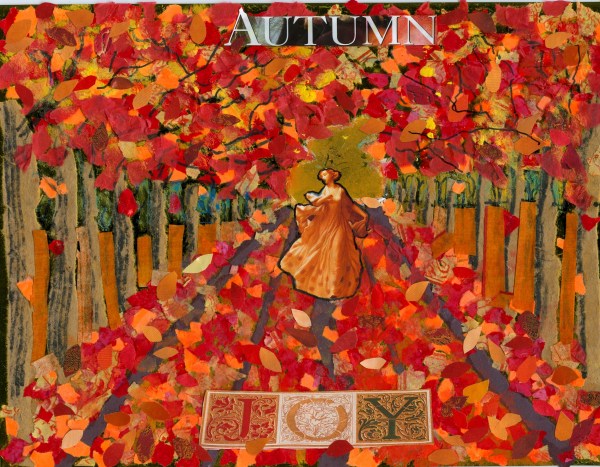
Autumn Joy: A collage by Mollie Pearce McKibbon

Autumn’s End

by Mollie Pearce McKibbon  October 2012

The golden gowns of Autumn

Are tarnished now and shed

By Octobers scathing winds;

In tatters they are spread.

Scarlet robes vainglorious

Lie trampled underfoot

As bonfires bright burn up the night

Turning all to ash and soot.

The burnished moon of harvest

Is shrunken small and wan,

And all of summer’s singers

Have flown their nests and gone.

Adeline’s Journal: Part 5

Adeline’s Journal: A fictional account of a young woman’s life during the War of 1812.

Copyright 2012 by Mollie Pearce McKibbon

Friday, Oct. 16, 1812

Oh Janetta,

We almost lost Henry today. It was a terrifying moment that seemed to last hours.  Henry has been so brave about it all and Mother won’t stop fussing over him.  But, I must tell you this might have happened even if we had not been at war.  It was one of the frightful possibilities of this wild country.  

Mother and Evvy were making bread at the time.  I was pulling turnips from the garden, getting them ready for winter storage.  We have very harsh winters here.  I heard Henry calling from the barn where he had gone to milk the cow.  I dropped my spade and went to see what was wrong.  Our barn is just a bit larger than our house and has only two windows, both open to the air, one large for tossing down hay bales and one small.  They don’t let in a lot of light, because of the tall trees behind the barn.  There are three stalls, one for our two horses and one for our cow.  We have a lot of farm implements hanging on the opposite wall or leaning up against it.  I could hear Henry, but I couldn’t see him at first.  

“Henry, has Molly trod on your foot ?” I asked.

“Get Father’s gun, Addie,” he replied .  I still couldn’t see him but I could hear something snarling and Molly lowing.

The horse stalls were empty, because Father had gone to help William cut his hay.  He usually kept his gun with him during the day, so I knew there was no use going to look for it. I picked up the pitchfork and walked cautiously towards  Molly’s  stall.  By then my eyes had adjusted to the dimness of the barn and I could see my little brother  at Molly’s  head, his hand gently stroking her muzzle.  There, behind her, crouched with its teeth bared and back bristled, was a  tawny cougar.

I have to tell you, Janetta, that I never once thought I was in danger. All I knew was that I must do something to protect Henry.  I gripped that pitchfork with both hands and lunged directly at the cat.  I fell short of killing it but the fork grazed its ribs and it turned on me furiously, at which point I lunged again, this time more successfully.  Hearing the commotion, Mother and Evvy rushed to the barn, in time to see Henry hit the wounded cat soundly on its head with a shovel.  

Mother screamed and grabbed Henry.  Evvy stood still staring at me in shock.  I began to shudder and couldn’t stop shaking.  Henry made sure the cougar was dead and retrieved the pitchfork.  

Permit me to state, dear Janetta, that I was never so frightened in all my life.  Father later said that it was a young cougar, probably half-starved, that had smelled the cow and entered the barn.  William thought perhaps it may have been in the early stages of hydrophobia, because cougars usually keep away from mankind.  To be on the safe-side, Father and William donned gloves, dragged the cougar away and burned it and the wooden pitchfork.

Later, Father spoke to Henry, Evvy and me very seriously, telling us that he had decided, because he and William might be called away in the militia, we must learn to shoot a musket to protect each other, but because it would upset her, Mother must never know.

I know I shall be dreaming about that cougar tonight.  I don’t like to hurt God’s creatures, but I am so thankful that there isn’t yet another grave in the orchard.

Thankfully, Adeline

Sunday, November 1, 1812


Dearest Janetta,

It is much colder now and the frost gets heavier every day.  A few snowflakes fell yesterday, but not enough to deter Evvy and me from our weekly visit to Elizabeth.  Elizabeth asked Mother if we could come to see her on Saturday mornings as she was very lonely without female company.  It is true of course, that Elizabeth does get lonely when William is working in their bush or spending time with the militia, but it is partly to hide from Mother, what William and Father are teaching us, all three of us.  It is no problem for Father to teach Henry.  It is expected that a son should know how to shoot.  I doubt that even Mrs. Randall and her sister, Miss Blaine, would approve of three young ladies learning to shoot a musket.  I expect even Charles would be shocked.

However, Father is determined that we become capable of protecting our home from intruders, animal or enemy.  William is just as concerned for Elizabeth.  In the past few weeks we have learned to load and shoot Father’s and William’s muskets.  Shooting is one thing; actually making the musket ball go where it is intended is quite something else.  Evvy, Elizabeth and I are improving somewhat, but it has taken some discipline to overcome the tendency to shut one’s eyes when pressing on the trigger.  Father says, if nothing else, the noise we make and the shock of seeing a woman with a musket, should scare anything off.

Corporal Charles Houghton, rode up from Fort Wellington, to bring us the latest news of the war.  It is very encouraging and yet so very sad.  Despite overwhelming odds, General Isaac Brock and his valiant troops met the American forces in the Battle of Queenston Heights and won the day on October 13.  Sadly, General Brock was also killed during the hard-fought battle.

Charles said that the flag hung at half-mast for a week at the fort.  General Proctor will now be in command of our forces.  

Charles has paid me a very kind compliment about my smile.  He said it lifted his spirits immensely and that he would be honoured if I would accept a poem he had written in my honour.  Of course I thanked him and blushed.

He pressed a very pretty scroll wrapped with a lovely blue satin ribbon into my hands.  He asked me not to read it until he had left and so I said I would not. When I did open the scroll, it was addressed to the “Heroine of My Heart” and was praising my killing of the cougar.  It made me blush to read such flowery praise.  I don’t think William or Father would have approved but no other person shall ever see it, not even Evvy.

Secretly, Adeline.  

Paisley Power

Creating textile designs, prints and surface patterns for fashion, accessories, furnishing, homeware, logos, stationery, packaging, theatre and art

My Spirals

• Hugs and Infinities

Poesy plus Polemics

Words of Wonder, Worry and Whimsy

Be Inspired..!!

Listen to your inner self..it has all the answers..

SouL SpeakS

He started Writing, The paper started speaking...

On Art and Aesthetics

Publication + Consultancy. Championing creative talent before a mass audience. Passionately global.

the poet's billow

a resource for moving poetry

cancer killing recipe

Inspiration for meeting life's challenges.

Dollar Store Children Sermons

RCL and Narrative Lectionary Based Children Sermons

The doll follies

A continuing story acted out with dolls and miniatures

Take Time To Create

A Creative Blog About Taking Time To Create New and Wonderful Things

createdbymeggan

Poetry, Journal

Around ZuZu's Barn

Conversations with Kindred Spirits

m i s s c a l y

Oh the wonders in creativity...